
Closed Yoke
Unknown Artist
7th–9th century
Medium
Basalt (andesite, feldspar/diopside (?))
Dimensions
H. 18 13/16 x 1W. 5 x D. 4 1/4 in. (47.9 x 38.1 x 10.8 cm)
Classification
Stone-Sculpture
Culture
Veracruz
Department
Arts of Africa, Oceania, and the Americas
Museum
Metropolitan Museum of Art, New York, NY
Credit
The Michael C. Rockefeller Memorial Collection, Bequest of Nelson A. Rockefeller, 1979
Accession Number
1979.206.445
Rights
Public Domain
Art Historical Context
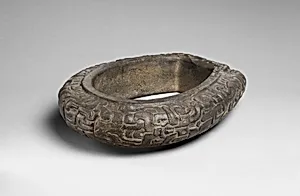
This striking *Closed Yoke* from, Mexico, dates to the7th–9th, a vibrant period in pre-Columbian Mesoamerica the region's cultures flourished along the Gulf Coast. Carved from dense basalt—likely andesite with feldspar or diopside—the sculpture measures about 19 inches high, 13 inches wide, and 4 deep, its substantial form evoking the strength of the stone itself. As a stone sculpture from the Arts of, Oceania, and the Americas, it exemplifies the masterful craftsmanship of anonymous Veracruz artisans, who shaped hard volcanic rock with precision using simple stone tools. Yokes like this were essential protective gear worn by players in the sacred Mesoamerican ballgame, a ritual sport blending athleticism, religion, and cosmology. The "closed" design, distinct from open U-shaped variants, may have hugged the wearer's waist more securely during intense play, symbolizing fertility, warfare, or cosmic forces central to Veracruz society. These objects highlight the culture's sophisticated stoneworking tradition, often featuring bold, minimalist forms that prioritize function and symbolism over elaborate decoration. Now part of The Michael C. Rockefeller Memorial Collection at The Metropolitan Museum of Art, this yoke invites us to ponder the thunderous echoes of ancient ball courts and the enduring legacy of Veracruz artistry. (198 words)