
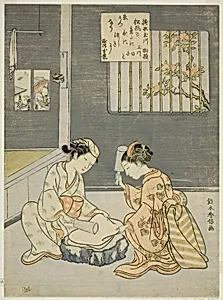
Cloth-fulling Jewel River, from an untitled series of Six Jewel Rivers
c. 1767
Medium
Color woodblock print; chuban
Dimensions
26.3 × 20.2 cm (10 3/8 × 7 15/16 in.)
Classification
woodblock print
Department
Arts of Asia
Museum
Art Institute of Chicago
Accession Number
34448
Rights
Public Domain
Art Historical Context
Suzuki Harunobu's *Cloth-fulling Jewel*, created around 1767, is a charming color woodblock print from an untitled series depicting the Six Jewel Rivers—poetic beauty spots celebrated in Japanese literature for their scenic splendor. This chuban-format print (a compact 26.3 × 20.2 cm) captures women engaged in the traditional labor of fulling cloth by a serene riverbank, blending everyday rural life with the lyrical allure of nature. Harunobu, a pioneering ukiyo-e artist during Japan's Edo period, revolutionized printmaking by introducing full-color nishiki-e techniques around 1765, allowing vibrant hues and subtle gradations that brought his intimate scenes to life. The artwork exemplifies Harunobu's mastery of delicate lines and harmonious palettes, evoking a sense of quiet elegance and seasonal beauty. Cloth fulling, a rhythmic task often romanticized in poetry, symbolizes purity and renewal, tying into broader ukiyo-e themes of the "floating world"—fleeting pleasures amid nature's embrace. As one of the earliest full-color series prints, it reflects the growing popularity of affordable art for urban audiences in 18th-century Japan, making high artistry accessible beyond the elite. Housed in the Art Institute of Chicago's Arts of Asia collection, this piece invites visitors to appreciate how Harunobu transformed woodblock printing into a vivid medium for storytelling, bridging labor, landscape, and cultural nostalgia.
About the Artist
Suzuki Harunobu · 1725–1770
Suzuki Harunobu (c. 1725-1770) was a Japanese ukiyo-e artist who revolutionized woodblock printing by developing nishiki-e—full-color prints using multiple woodblocks—in 1765. Before Harunobu, Japanese prints were limited to two or three colors; his innovation unleashed the entire artist's palette, transforming ukiyo-e into the vibrant art form that would later captivate Western artists from Manet...