
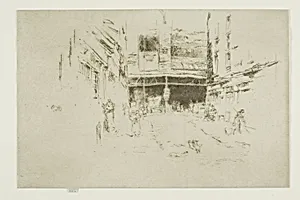
Clothes-Exchange, Houndsditch, No. 1
Medium
Etching and drypoint with foul biting in dark brown ink on buff laid paper
Dimensions
Image, trimmed within platemark: 15.8 × 23.9 cm (6 1/4 × 9 7/16 in.); Sheet: 16.1 × 23.9 cm (6 3/8 × 9 7/16 in.)
Classification
etching
Department
Prints and Drawings
Museum
Art Institute of Chicago
Accession Number
29466
Rights
Public Domain
Art Historical Context
James McNeill Whistler, renowned 19th-century artist celebrated for his subtle tonal harmonies and innovative prints, captured the gritty vibrancy of London's East End *Clothes-Exchange,oundsditch, No. 1* (1887). This etching a bustling street market in Houndsditch, a historic Jewish immigrant neighborhood known for its second-hand clothing trade amid Victorian poverty. Whistler's work reflects his fascination with urban life during a time of rapid industrialization and social disparity, part of his later series exploring London's overlooked corners. Masterfully executed in etching, drypoint, and foul biting on buff laid paper, the print showcases Whistler's technical prowess. Etching involves acid to bite intricate lines into a metal plate, while drypoint adds velvety burrs from direct needle scratches, creating rich textures. The "foul biting"—unintended corrosion—lends an atmospheric grit, enhancing the scene's moody depth in dark brown ink. Trimmed to just 15.8 × 23.9 cm, its intimate scale invites close viewing, emphasizing Whistler's belief in "art for art's sake" over narrative detail. Housed in the Art Institute of Chicago's Prints and Drawings collection, this piece exemplifies Whistler's influence on modern printmaking, bridging Realism and Aestheticism for a poetic glimpse into everyday struggle.
About the Artist
James McNeill Whistler · 1834–1903
James Abbott McNeill Whistler (1834-1903) was an American-born painter and printmaker who became a leading figure in the Aesthetic Movement and pioneer of Tonalism and Japonisme. He revolutionized art by championing "art for art's sake" and treating paintings as visual equivalents of musical compositions, titling works as "arrangements," "harmonies," and "nocturnes" to emphasize formal qualities o...