
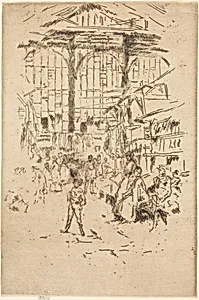
Clothes Exchange, No.II
c. 1886/1888
Medium
etching and drypoint on laid paper
Dimensions
overall (trimmed to plate): 22.7 × 15.2 cm (8 15/16 × 6 in.)
Classification
Department
CG-W
Museum
National Gallery of Art, Washington, D.C.
Credit
Rosenwald Collection
Accession Number
1943.3.8592
Rights
Public Domain
Art Historical Context
James McNeill Whistler, renowned 19th-century artist celebrated for his "art for art's sake philosophy and ties to the Aesthetic movement, *Clothes Exchange, No II* around 1886–1888. This intimate print captures everyday urban life, likely drawing from London's bustling markets orshops where secondhand clothes were traded—a poignant reflection of Victorian society's underbelly amid rapid industrialization. Whistler's keen eye for subtle social scenes elevated such motifs into elegant compositions, blending Realism with his signature tonal harmony. Masterfully executed in etching and drypoint on laid paper, the work showcases Whistler's printmaking prowess. Etching allowed precise line work bitten by acid into a copper plate, while drypoint's direct scratching produced velvety burrs for rich, atmospheric textures—techniques he perfected in series like his Venice etchings. At just 22.7 × 15.2 cm, the trimmed plate size invites close viewing, revealing delicate modulations of light and shadow that rival his paintings. Housed in the National Gallery of Art's Rosenwald Collection, this print exemplifies Whistler's influence on modern printmaking, prioritizing mood over narrative. Visitors will appreciate its quiet poetry, a window into late 19th-century life through one of art history's most innovative etchers.
About the Artist
James McNeill Whistler · 1834–1903
James Abbott McNeill Whistler (1834-1903) was an American-born painter and printmaker who became a leading figure in the Aesthetic Movement and pioneer of Tonalism and Japonisme. He revolutionized art by championing "art for art's sake" and treating paintings as visual equivalents of musical compositions, titling works as "arrangements," "harmonies," and "nocturnes" to emphasize formal qualities o...