
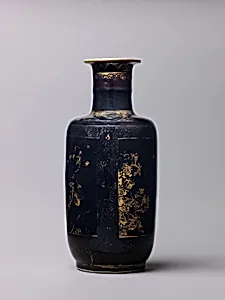
Club-shaped vase
1662–1722
Medium
Porcelain with mirror-black glaze, painted in overglaze gilt.
Dimensions
Height: 10 in. (25.4 cm.)
Classification
Ceramics
Culture
Chinese
Department
Robert Lehman Collection
Museum
Metropolitan Museum of Art, New York, NY
Credit
Robert Lehman Collection, 1975
Accession Number
1975.1.1739
Rights
Public Domain
Art Historical Context
This exquisite club-shaped vase, crafted in China during the Kangxi period (1662–1722) of the Qing dynasty, exemplifies the's mastery of porcelain artistry. Standing at 10 inches tall, it features a striking mirror-black glaze—a glossy, reflective finish achieved through precise control of firing temperatures and copper oxide in the kiln. This technique produced a luxurious, almost metallic sheen, prized by collectors for its technical sophistication and visual allure. Adorned with intricate overglaze gilt paintings, the vase showcases delicate gold motifs applied after the initial glazing and fired at lower temperatures to preserve their vibrancy. Such innovations highlighted China's dominance in ceramics during the late 17th and early 18th centuries, when imperial kilns at Jingdezhen supplied both domestic elites and global markets. The club shape, with its elegant, bulbous form, reflects playful yet refined vessel designs popular in scholarly and decorative contexts. Now part of the Robert Lehman Collection at The Metropolitan Museum of Art (acquired 1975), this piece invites visitors to appreciate the fusion of form, glaze, and gilding that defined Qing porcelain's golden age— a testament to enduring Chinese ceramic ingenuity.
About the Artist
Chinese
The artist known simply as "Chinese" in museum records represents the vast tradition of anonymous or unattributed masters in Chinese art history, with 99 works preserved in our collection. These pieces exemplify the enduring legacy of guó huà, or traditional Chinese painting, one of the world's oldest continuous artistic practices. Early life is not well documented, as is common for many practitio...