
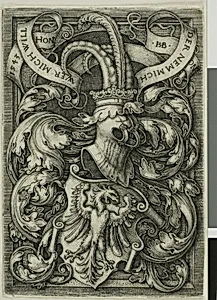
Coat of Arms with an Eagle
Medium
Engraving in black on ivory laid paper
Dimensions
Image/sheet, trimmed to platemark: 7.2 × 5 cm (2 7/8 × 2 in.)
Classification
engraving
Department
Prints and Drawings
Museum
Art Institute of Chicago
Accession Number
77475
Rights
Public Domain
Art Historical Context
Step into the intricate world of Renaissance printmaking with *Coat of Arms with an Eagle*, a masterful 1543 engraving by Hansald Beham. This tiny gem, measuring just 7.2 × 5 cm and printed in black ink on delicate ivory laid paper, exemplifies the precision of the German "Little Masters"—engravers renowned for their diminutive yet detailed works. Housed in the Art Institute of Chicago's Prints and Drawings Department, it captures a heraldic eagle perched boldly within a coat of arms, symbolizing imperial power and noble lineage in the Holy Roman Empire. Beham, a Nuremberg artist active during the Northern Renaissance (c. 1500–1550), specialized in ornamental designs and small-scale engravings that could be widely collected and displayed. The engraving technique—incising lines into a copper plate with a burin, inking it, and pressing onto paper—allowed for exceptional fine lines and textures, making heraldry accessible beyond elite commissions. Ivory laid paper, with its subtle texture from wire molds, enhanced the print's luminosity and durability. In 16th-century Europe, such coats of arms served practical and prestigious purposes: adorning manuscripts, seals, and homes while reinforcing social hierarchies. Beham's eagle, likely evoking the double-headed imperial bird, reflects the era's fascination with symbolism amid political turbulence. This work invites us to marvel at how a pocket-sized print encapsulated grandeur and artistry.
About the Artist
Hans Sebald Beham · 1500–1550
Sebald Beham (1500-1550), often called Hans Sebald Beham, was a German painter and printmaker born in Nuremberg. He stands as the most important figure among the Kleinmeister (Little Masters), a group of German artists who created remarkably detailed prints on a diminutive scale in the generation following Albrecht Dürer. Beham's significance lies in his technical virtuosity and unprecedented pro...