
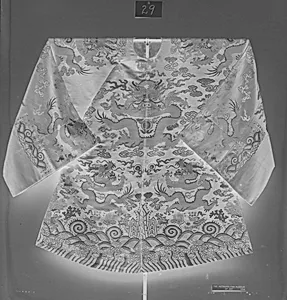
Coat with Buddhist and Taoist Symbols
Unknown Artist
late 18th–early 19th century
Medium
Silk, metallic thread
Dimensions
41 x 78 in. (104.14 x 198.12 cm)
Classification
Costumes-Woven
Culture & Period
China · Qing dynasty (1644–1911)
Department
Asian Art
Museum
Metropolitan Museum of Art, New York, NY
Credit
Bequest of William Christian Paul, 1929
Accession Number
30.75.29
Rights
Public Domain
Tags
Art Historical Context
This exquisite silk coat, woven with metallic threads during China’s Qing dynasty in the late 18th to early 19th century, exemplifies the luxurious textile traditions of imperial China. Created as a woven costume rather than painted artwork, it reflects the high status of its likely wearer—possibly a member of the nobility or court—where such garments served both practical and symbolic purposes. The intricate use of silk and gold or silver threads highlights the advanced weaving techniques of the period, allowing for shimmering effects that caught the light during processions or ceremonies. The coat’s surface is adorned with dragons alongside Buddhist and Daoist symbols, illustrating the syncretic religious landscape of Qing China. Dragons, long associated with imperial power and protection, coexist here with motifs representing harmony between Buddhism and Daoism, two traditions that often blended in everyday spiritual practice. This combination underscores the Qing court’s tolerance and integration of diverse beliefs, turning the garment into a wearable expression of cultural and spiritual identity. Housed in the Metropolitan Museum of Art’s Asian Art collection, this piece offers visitors a tangible connection to Qing-era craftsmanship and worldview. Its preservation as a bequest highlights how such textiles continue to educate us about the artistry and layered symbolism embedded in Chinese costume history.