
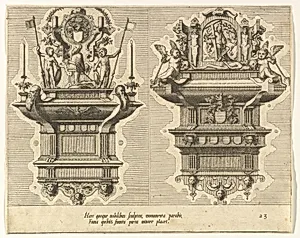
Cœnotaphiorum (23)
Medium
Etching; first state of four
Dimensions
sheet: 6 11/16 x 8 3/8 in. (17 x 21.2 cm)
Classification
Prints|Ornament & Architecture
Department
Drawings and Prints
Museum
Metropolitan Museum of Art, New York, NY
Credit
Purchase, Phyllis D. Massar Gift, 2011
Accession Number
2011.510.23
Rights
Public Domain
Tags
Art Historical Context
This etching, titled *Cœnotaphiorum (23)*, was created in 1563 by the Flemish architect and designer Hans Vredeman de Vries in collaboration with the printmakers Johannes and Lucas van Doetecum and publisher Hieronymus Cock. Measuring just over six by eight inches, the work belongs to a series of ornamental prints depicting elaborate cenotaphs—monumental empty tombs intended to honor the deceased. Executed in the delicate medium of etching during the height of the Northern Renaissance, it reflects the period’s fascination with classical architecture and funerary splendor. Vredeman de Vries was celebrated for his inventive perspective views and architectural fantasies, which served both as artistic designs and practical models for builders and patrons. Here, the composition features grand tomb structures adorned with sculptural figures, including men, women, and playful putti, blending solemn memorial themes with decorative elegance. As part of the Metropolitan Museum’s collection of prints and ornament, the sheet exemplifies how such works circulated widely across Europe, influencing tomb design and interior decoration in the sixteenth century. The first state of four, this impression captures the crisp lines and intricate details typical of early impressions from the van Doetecum workshop. Its modest scale belies the grandeur it evokes, offering viewers a window into Renaissance ideas about memory, status, and the enduring power of architecture.