
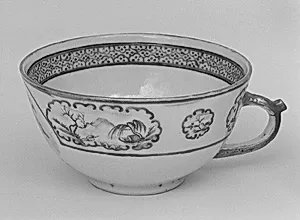
Coffee cup (part of a service)
Unknown Artist
ca. 1800–1805
Medium
Hard-paste porcelain
Dimensions
Height: 1 7/8 in. (4.8 cm)
Classification
Ceramics-Porcelain-Export
Culture
Chinese, for Portuguese market
Department
European Sculpture and Decorative Arts
Museum
Metropolitan Museum of Art, New York, NY
Credit
Helena Woolworth McCann Collection, Gift of Winfield Foundation, 1951
Accession Number
51.86.133
Rights
Public Domain
Tags
Art Historical Context
This delicate coffee cup, part of larger porcelain service crafted in China around 1800–1805, exemplifies the pinnacle of hard-paste porcelain production from Jingdezhen kilns. Standing just 1 7/8 inches tall, it was designed for the Portuguese market, reflecting the vibrant export trade that flourished during the Qing dynasty. European demand for Chinese ceramics surged in the late 18th and early th centuries, with Portuguese traders importing vast quantities of these luxury goods, often customized with armorial crests or scenic motifs to suit Western tastes. Adorned with finely painted landscapes and trees, the cup showcases the meticulous underglaze blue technique typical of export porcelain. These naturalistic scenes—evoking serene Chinese gardens or distant vistas—blend Eastern artistry with Western functionality, transforming everyday rituals like coffee drinking into elegant affairs. Hard-paste porcelain's translucent quality and durability made it prized over softer European imitations, symbolizing status and global exchange. A gift to the Metropolitan Museum of Art from the Helena Woolworth McCann Collection in 1951, this piece invites us to ponder the invisible threads of history: porcelain ships crossing oceans, blending cultures in a single sip.