
Coffee service
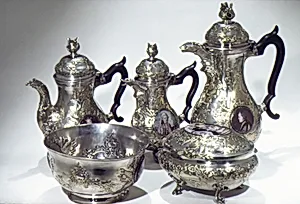
Medium
Silver, parcel gilt, enamel, wood
Dimensions
See individual records
Classification
Metalwork-Silver In Combination
Culture
Russian, St. Petersburg
Department
European Sculpture and Decorative Arts
Museum
Metropolitan Museum of Art, New York, NY
Credit
Rogers Fund, 1947
Accession Number
47.51.1–.5
Rights
Public Domain
Art Historical Context
This exquisite coffee service, crafted in 1773 by silversmith Johan Henrik Blom and enameler Pietro Rotari in St. Petersburg Russia, exemplifies the opulent metalwork of Catherine the Great's era. during the height of the Russian Empire's neoclassical revival, it reflects the imperial court's fascination with refined domestic luxury. Coffee services like this were prized status symbols, enabling elegant social rituals among the aristocracy, where serving coffee became a sophisticated display of hospitality. The service combines silver with parcel gilding—selective application of gold for shimmering highlights—vibrant enamel decorations, and wooden elements, showcasing masterful techniques in chasing, repoussé, and painted enameling. These methods, honed in St. Petersburg's renowned workshops, elevated functional objects into art, blending durability with jewel-like beauty. The Metropolitan Museum of Art's example, acquired through the Rogers Fund in 1947, highlights the fusion of Russian craftsmanship with European influences. Housed in the Department of European Sculpture and Decorative Arts, this piece offers a window into 18th-century elite culture, where such sets underscored Russia's emergence as a powerhouse of decorative arts. Visitors will appreciate its intricate details, evoking the grandeur of imperial salons.