
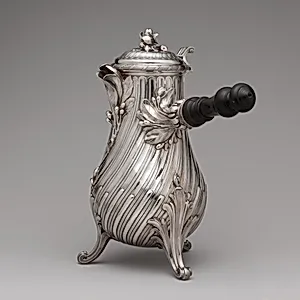
Coffeepot
Medium
Silver with ebony handle
Dimensions
Overall (with handle): 11 5/8 × 12 in. (29.5 × 30.5 cm)
Classification
Metalwork-Silver
Culture
French, Paris
Department
European Sculpture and Decorative Arts
Museum
Metropolitan Museum of Art, New York, NY
Credit
Purchase, Joseph Pulitzer Bequest, 1933
Accession Number
33.165.1
Rights
Public Domain
Art Historical Context
This elegant coffeepot, crafted in 1757 by François-Thomas Germain, exemplifies the opulence of mid-18th-century French Roc silverwork. Germain, a master silversmith and successor to his renowned father, François-Thomas I, served as the official supplier to the French royal court under Louis XV. Working in Paris, he was celebrated for his intricate designs that blended functionality with lavish ornamentation, often featuring scrolling motifs, shells, and floral elements typical of the Rococo style—a playful reaction to the grandeur of Baroque art. Made of gleaming silver with a finely carved ebony handle for heat resistance and grip, the coffeepot measures 11 5/8 × 12 inches overall, ideal for serving the era's fashionable hot beverages. Silverware like this was a status symbol among the aristocracy, reflecting the growing coffee culture imported from the Ottoman Empire and popularized in Parisian salons. Germain's piece showcases advanced metalworking techniques, including chasing and repoussé, which created textured, three-dimensional surfaces that caught the light in aristocratic dining rooms. Acquired by The Metropolitan Museum of Art in 1933 through the Joseph Pulitzer Bequest, this coffeepot offers a window into the refined tastes and craftsmanship of pre-Revolutionary France, where everyday luxury underscored social hierarchy.