
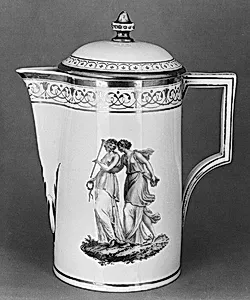
Coffeepot (part of a coffee service)
early 19th century
Medium
Hard-paste porcelain
Dimensions
Height: 6 3/4 in. (17.1 cm)
Classification
Ceramics-Porcelain
Culture
German, Nymphenburg
Department
European Sculpture and Decorative Arts
Museum
Metropolitan Museum of Art, New York, NY
Credit
Bequest of George White Thorne, 1883
Accession Number
83.1.27a, b
Rights
Public Domain
Tags
Art Historical Context
This elegant coffeepot, part a luxurious coffee service crafted by the renowned Nymphenburg Porcelain Manactory in Bavaria, Germany, dates to the early 19th century Founded in 1747 as a royal enterprise, Nymphenburg synonymous with the finest European porcelain, rivaling Meissen and Sèvres. During this Neoclassical era, the manufactory produced sophisticated tablewares for Europe's aristocracy, blending technical mastery with refined decoration—often featuring graceful female figures, as suggested by the artwork's motifs. Made of hard-paste porcelain, a durable and translucent material perfected in Europe to mimic prized Chinese imports, the coffeepot stands just 6 3/4 inches tall, ideal for intimate social rituals. Coffee services like this symbolized refined hospitality in post-Napoleonic Germany, where caffeinated gatherings fostered conversation among the elite. The meticulous hand-painting, gilding, and modeling highlight Nymphenburg's artistic prowess, transforming everyday objects into miniature masterpieces. Bequeathed to the Metropolitan Museum of Art in 1883 by George White Thorne, this piece exemplifies the enduring allure of Nymphenburg's output, bridging utility and opulence in European decorative arts. Visitors can appreciate how such wares elevated domestic life into high art.