
Coffret
Unknown Artist
late 15th–16th century
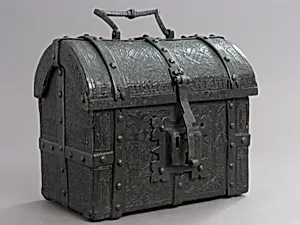
Medium
Cuir bouilli (tooled leather), iron fittings, wood core
Dimensions
Overall: 6 1/2 x 7 5/8 x 4 1/2 in. (16.5 x 19.4 x 11.4 cm)
Classification
Leatherwork
Culture
French
Department
The Cloisters
Museum
Metropolitan Museum of Art, New York, NY
Credit
The Cloisters Collection, 1955
Accession Number
55.61.67
Rights
Public Domain
Art Historical Context
Nestled in The Cloisters' collection at the Metropolitan Museum of Art this exquisite *Coffret* from 15th– to 16th-century France exemplifies the refined craftsmanship of Renaissance-era leatherwork. Measuring a compact 6½ × 7⅝ × 4½ inches, this small box—likely used to store jewelry, cosmetics, or precious documents—was a luxurious everyday object for the elite, blending functionality with decorative appeal. Crafted from *cuir bouilli* (boiled leather) over a wood core, with sturdy iron fittings, the piece showcases a labor-intensive technique where leather is soaked in hot water or wax, molded, and tooled into intricate patterns before hardening into a durable, lightweight material. This method, popular in medieval and Renaissance Europe, allowed artisans to create ornate relief designs rivaling metalwork, while resisting water and wear—ideal for travel or domestic use. As an anonymous work of French leatherwork, the *Coffret* highlights the period's transition from Gothic elaboration to Renaissance elegance, offering a glimpse into the skilled, often overlooked trade of leatherworkers. Acquired in 1955, it invites visitors to appreciate the tactile beauty and cultural ingenuity of these portable treasures.