
Coin
Unknown Artist
dated A.H. 363/ 973–74 CE
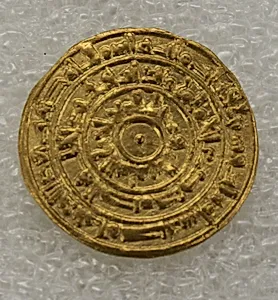
Medium
Gold
Dimensions
Diam. 7/8 in. (2.2 cm)
Classification
Coins
Department
Islamic Art
Museum
Metropolitan Museum of Art, New York, NY
Credit
Gift of Darius Ogden Mills, 1904
Accession Number
04.35.3340
Rights
Public Domain
Art Historical Context
This delicate gold coin, struck in A.H. 363 (973–74 CE), offers a window into the flourishing Islamic world of the 10th century. Measuring just 7/8 inch in diameter, it exemplifies the precision of medieval minting techniques, where pure gold was hammered into thin, flawless discs. As a dinar—one of the primary currencies of the Abbasid Caliphate its regional powers—this piece circulated across vast trade networks from the Mediterranean to Central Asia, underscoring Islam's pivotal role in global commerce. In the Department of Islamic Art at the Metropolitan Museum of Art, gifted by Darius Ogden Mills in 1904, the coin highlights the artistry of Islamic numismatics. Unlike figural coins of earlier empires, Islamic dinars typically featured elegant Arabic inscriptions—often Qur'anic verses, dates, and mint marks—rendered in Kufic script. This aniconic style reflected religious principles while showcasing calligraphic mastery, blending functionality with aesthetic refinement. Such coins were not mere money but symbols of caliphal authority and cultural sophistication. Imagine holding a tangible link to a golden age of scholarship and exchange—visitors can ponder its journeys through bustling bazaars, evoking the interconnected vibrancy of medieval Islam. (198 words)