
Coin
Unknown Artist
dated A.H. 375/ 985 CE
Medium
Silver
Classification
Coins
Department
Islamic Art
Museum
Metropolitan Museum of Art, New York, NY
Credit
Rogers Fund, 1939
Accession Number
39.40.127.57
Rights
Public Domain
Art Historical Context
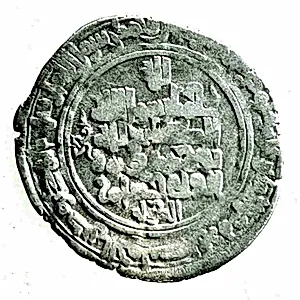
This exquisite silver coin, minted in A.H. 375 (985 CE), offers a glimpse into the vibrant of medieval Islamic civilization. Produced during the late Abbasid Caliphate—likely under Buyid influence in regions like Persia or Iraq—it exemplifies the dirhem, a standard silver currency that facilitated trade across the vast Islamic empire, from the Mediterranean to Central Asia. As a product of the Islamic Art tradition, such coins were not mere money but finely crafted artifacts, blending functionality with artistry. Crafted in silver, the coin's medium was chosen for its durability and portability, essential for bustling markets and long-distance commerce along the Silk Road. Islamic numismatic art famously eschewed human or animal figures in favor of elegant Arabic calligraphy, often in the angular Kufic script, bearing inscriptions of the caliph's name, mint location, and date. This aniconic style reflected religious principles while turning everyday objects into portable expressions of faith and authority. Housed in the Metropolitan Museum of Art's Islamic Art department through the Rogers Fund of 1939, this coin invites visitors to ponder the interconnectedness of economy, politics, and aesthetics in 10th-century Islam. Its survival underscores how numismatics preserves history where texts alone fall short, revealing shifts in power and cultural flourishing.