
Coin Weight
Unknown Artist
10th–11th century
Medium
Glass
Dimensions
H. 3/16 in. (0.5 cm) Diam. 7/8 in. (2.2 cm) Wt. 0.1 oz. (2.8 g)
Classification
Glass
Department
Islamic Art
Museum
Metropolitan Museum of Art, New York, NY
Credit
Rogers Fund, 1908
Accession Number
08.256.49
Rights
Public Domain
Tags
Art Historical Context
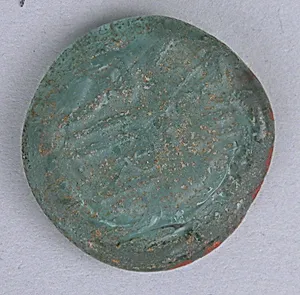
This delicate glass coin weight, dating to the 10th–11th century, hails from the Islamic world and the era's precision craftsmanship Measuring just 7/8 inch in diameter and weighing a mere 0.1 ounce, it was designed for a practical purpose: verifying the weight of gold dinars or silver dirhams bustling trade hubs. Acquired through the Rogers Fund in 8, it now resides in the Metropolitan Museum Art's Department of Islamic Art. In medieval Islamic society, accurate weights and measures were vital for commerce across vast empires, from Baghdad to Cairo. These small objects ensured fair exchange in markets teeming with merchants from Europe to India, reflecting the Abbasid or Fatimid caliphates' advanced metrology. Often molded or cast, glass weights like this one were favored for their transparency and uniformity, allowing users to inspect for flaws. The use of glass as a medium highlights Islamic artisans' mastery of the material, achieved through sophisticated blowing, molding, and annealing techniques. Though functional, such items carry cultural weight, symbolizing the era's economic sophistication and trust in standardized systems that fueled the Islamic Golden Age. A tiny marvel, it invites us to ponder the unseen hands behind everyday precision.