
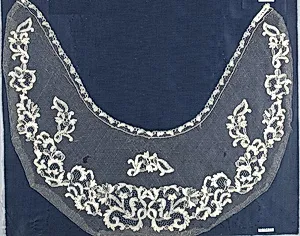
Collar
Unknown Artist
19th century
Medium
Machine net
Dimensions
L. 19 x W. 7 1/2 inches 48.3 x 19.1 cm
Classification
Textiles-Laces
Culture
German, Saxony
Department
European Sculpture and Decorative Arts
Museum
Metropolitan Museum of Art, New York, NY
Credit
Rogers Fund, 1910
Accession Number
10.154.20
Rights
Public Domain
Art Historical Context
This delicate collar, crafted in 19th-century Saxony, Germany, exemplifies the region's renowned textile heritage. Made from machine net—a lightweight, openwork fabric produced on early industrial looms—the piece measures 19 by 7½ inches (48.3 x 19.1 cm). Housed in The Metropolitan Museum of Art's Department of European Sculpture and Decor Arts and classified among textiles-laces, it was acquired through the Rogers Fund in 0. Saxony's position as a hub for lace innovation made such items both luxurious accessories and everyday adornments for collars, cuffs, and trims. The advent of machine net in the early 1800s revolutionized lace production, shifting from labor-intensive handmade techniques to efficient mechanized processes like the bobbinet loom. This allowed for finer, more affordable nets that mimicked handmade lace while enabling mass production. In Victorian-era fashion, collars like this one added refined femininity to bodices and blouses, reflecting Saxony's export-driven textile economy and the era's emphasis on intricate detailing. Though by an unknown artist, this collar highlights the artistry of industrial craftsmanship, bridging handmade tradition and modernity. Visitors can appreciate how such everyday elegance captured the zeitgeist of 19th-century Europe, where technology met timeless style.