
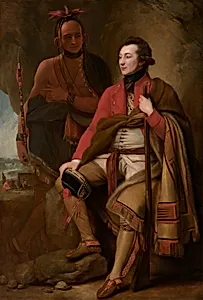
Colonel Guy Johnson and Karonghyontye (Captain David Hill)
1776
Medium
oil on canvas
Dimensions
overall: 202 x 138 cm (79 1/2 x 54 5/16 in.) framed: 222.6 x 160 x 9.5 cm (87 5/8 x 63 x 3 3/4 in.)
Classification
Painting
Department
CAB
Museum
National Gallery of Art, Washington, D.C.
Credit
Andrew W. Mellon Collection
Accession Number
1940.1.10
Rights
Public Domain
Art Historical Context
Benjamin West's *Colonel Guy Johnson and Karongontye (Captain David)*, painted in 1776, captures a pivotal moment amid the American Revolutionary War. The oil-on-canvas portrait (202 x 138 cm) depicts British Superintendent of Indian Affairs Guy Johnson alongside the Mohawk leader Karongontye, known as David Hill. Commissioned by Johnson himself, it symbolizes the strategic alliance between British forces and Native American nations, who supported the Crown against colonial rebels. West, a leading Anglo-American Neoclassical artist and historical painter to King George III, crafted this work during his time in London, blending portraiture with political symbolism. The painting's historical significance lies in its portrayal of colonial diplomacy and cross-cultural partnerships. Johnson, seated with a "talking stick" representing authority, and Karonghyontye, standing in traditional attire holding a peace pipe, embody unity and negotiation. This large-scale canvas reflects West's mastery of dramatic lighting and realistic detail, hallmarks of Neoclassicism, which drew from classical antiquity to elevate contemporary events. Today, housed in the National Gallery of Art's Andrew W. Mellon Collection, the artwork invites reflection on the complex legacies of empire, Indigenous alliances, and the Revolution's human dimensions—a timeless reminder of history's intricate alliances.
About the Artist
Benjamin West · 1738–1820
Benjamin West, born on October 10, 1738, in Springfield, Pennsylvania, emerged as one of the most influential painters of his era despite being entirely self-taught. Growing up in a Quaker family in colonial America, West displayed prodigious talent from childhood, creating portraits and religious scenes with materials gifted by local patrons. By his late teens, he had garnered enough support to t...