
Colosseum
early 17th century
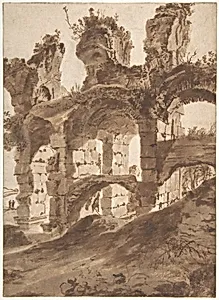
Medium
Pen and brown ink, brown wash.
Dimensions
10 1/2 x 7 5/8 in. (26.7 x 19.4 cm)
Classification
Drawings
Department
Drawings and Prints
Museum
Metropolitan Museum of Art, New York, NY
Credit
Rogers Fund, 1961
Accession Number
61.2.4
Rights
Public Domain
Tags
Art Historical Context
Bartholomeus Breen, a Dutch artist active during the early 17th century, captures the majestic ruins of Rome's Colosseum in this delicate drawing. Created during or shortly after his formative years in Italy (around 1619–1626), the work reflects the fascination of Northern European artists with ancient Roman architecture. Breenbergh, part of the Dutch Golden Age's Italianate tradition, specialized in landscapes and architectural vedute, often sketching directly from life to evoke the grandeur and melancholy of antiquity. Rendered in pen and brown ink with brown wash on a modest 10 1/2 x 7 5/8 in. sheet, the piece showcases Breenbergh's masterful technique. Fine ink lines delineate the Colosseum's iconic arches and weathered stone, while subtle washes build atmospheric depth, suggesting light filtering through the ruins. This intimate scale hints at a personal study, likely made en plein air, blending precise draftsmanship with tonal modeling for a sense of timeless decay. Housed in the Metropolitan Museum of Art's Drawings and Prints department (Rogers Fund, 1961), this artwork exemplifies how 17th-century travelers romanticized Roman ruins as symbols of empire's fragility. It invites visitors to ponder the Colosseum not just as a monument, but as a muse for artists bridging Northern precision with Italian splendor.
About the Artist
Bartholomeus Breenbergh · 1598–1657
Probably was apprenticed in Amsterdam. He was one of the early Dutch italianates, that is, northern artists who travelled to Italy in the 1620s and were inspired by southern landscapes. On his return, he settled in Amsterdam and his landscapes were developed as more severe and monumental, often with historical subjects; strongly influenced by the Pre-Rembrandtists. Comment on works: Landscapes; Ru...