
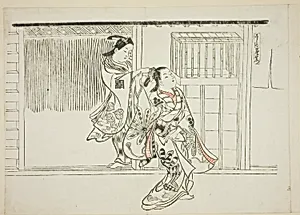
Comb Rashomon (Sashigushi Rashomon), no. 3 from a series of 12 prints depicting parodies of plays
c. 1716–35
Medium
Hand-colored woodblock print; oban, sumizuri-e
Dimensions
27.2 × 38.6 cm (10 3/4 × 15 1/4 in.)
Classification
woodblock print
Department
Arts of Asia
Museum
Art Institute of Chicago
Accession Number
19630
Rights
Public Domain
Art Historical Context
Step into the vibrant world of early 18th-century Edo Japan with *Comb Rashomon (Sashigushi Rashomon, no. 3 from a series of 12 by Okumura Masobu. Created around 1716–35, this hand-colored woodblock print captures playful spirit of uki-e, the "pictures of the floating world" that celebrated theater, fashion, and urban life. Masanobu, a pioneering artist, parodies a dramatic scene inspired by the legendary Rashomon Gate—famously linked to tales of ghosts and warriors—infusing it with humor through oversized combs, a nod to beauty and kabuki stage props. Printed in the sumizuri-e style (monochromatic ink prints), this oban-sized sheet (27.2 × 38.6 cm) showcases Masanobu's innovative techniques: precise woodblock carving for bold outlines and subtle shading, enhanced by delicate hand-coloring for vivid pops of red and gold. As one of the first artists to experiment with Western-inspired perspective and chiaroscuro, he elevated humble woodblocks into sophisticated art, bridging traditional Japanese printing with emerging realism. These theatrical parodies reflect Edo's booming kabuki culture, where actors were celebrities and satire thrived. Held in the Art Institute of Chicago's Arts of Asia collection, *Comb Rashomon* invites us to laugh at the absurdity of human vanity, a timeless delight from Japan's golden age of printmaking.
About the Artist
Okumura Masanobu · 1686–1764
Japanese, 1686–1764