
Combats et Triomphes
1540–83
Medium
Engraving, fourth state of four
Dimensions
Sheet: 2 5/8 × 8 11/16 in. (6.7 × 22 cm)
Classification
Prints
Department
Drawings and Prints
Museum
Metropolitan Museum of Art, New York, NY
Credit
Bequest of Phyllis Massar, 2011
Accession Number
2012.136.156.1
Rights
Public Domain
Tags
Art Historical Context
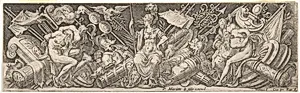
Etienne Delaune’s *Combats et Triomphes* (1540–83) is a finely detailed engraving that captures the dynamic interplay of conflict and victory through its elongated format. Measuring just over eight inches wide, the print’s narrow proportions suggest it was designed as a decorative frieze or ornamental band, possibly intended for use by goldsmiths, armorers, or bookbinders. As a fourth-state impression, it reflects the iterative nature of early printmaking, where the artist reworked the copper plate to refine details and extend its usability. Delaune, a French engraver active during the later Renaissance, worked in the elegant, elongated mannerist style associated with the School of Fontainebleau. The scene’s inclusion of armed female nudes points to allegorical or mythological subjects—perhaps Amazons or personifications of virtues triumphing over adversaries—common in 16th-century French art that blended classical themes with courtly ideals. Such prints helped spread sophisticated designs across Europe at a time when few could view original paintings or sculptures. Acquired by the Metropolitan Museum through the bequest of Phyllis Massar, this delicate work highlights the vital role of engravings in disseminating artistic ideas and technical virtuosity during the Renaissance. Its intimate scale rewards close looking, revealing the precision and narrative richness that made Delaune’s prints prized by collectors and craftsmen alike.
About the Artist
Etienne Delaune · 1514–1583
Comment on works: Draftsman; Engraver; Medalist