
Combination Hat Rack and Umbrella Stand
c. 1936
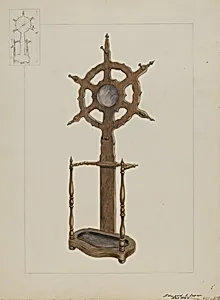
Medium
watercolor, colored pencil, graphite and heightening on paper
Dimensions
overall: 30.1 x 22.3 cm (11 7/8 x 8 3/4 in.) Original IAD Object: 86"high overall; 44"wide. See data sheet for dets.
Classification
Index of American Design
Department
CG-W
Museum
National Gallery of Art, Washington, D.C.
Credit
Index of American Design
Accession Number
1943.8.5397
Rights
Public Domain
Art Historical Context
In the bustling era of the Great Depression, artist Edward L. Loper the ingenuity of American craftsmanship with his1936 watercolor rendering *Combination Hat Rack and Um Stand*. Created as part of the Index of American Design—a Works Progress Administration (WPA) from 1935 to 1942—this detailed drawing (30.1 x 22.3 cm) documents towering original object standing 86 inches high and 44 inches wide. Loper's precise use of watercolor, colored pencil, graphite, and heightening on paper to life a multifunctional folk furniture piece, blending utility with elegant simplicity for everyday use. The Index of American Design commissioned over 15,000 such renderings to celebrate and preserve the nation's decorative arts heritage, from Shaker simplicity to Victorian whimsy. Loper, a Philadelphia-based artist, excelled in rendering three-dimensional forms with lifelike depth and subtle color gradients, heightening whites to mimic polished wood and metal accents. This hat rack and umbrella stand exemplifies early 20th-century (or earlier) American design, where practicality met modest ornamentation—ideal for entryways in modest homes. Today, housed in the National Gallery of Art's collection, Loper's work invites us to appreciate overlooked treasures of American material culture, reminding visitors of the WPA's vital role in supporting artists while safeguarding our shared history.
About the Artist
Edward L. Loper · 1916–2011
Edward Leroy Loper Sr. was born on April 7, 1916, in Wilmington, Delaware, to a poor family in the racially mixed Frogtown neighborhood, where he was raised primarily by his maternal grandmother. After graduating from Howard High School, the only secondary school available to African Americans in Delaware at the time, Loper received no formal artistic training initially but immersed himself in sel...