
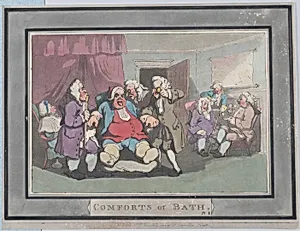
Comforts of Bath, Plate 1
January 6, 1798
Medium
Hand-colored etching and aquatint
Dimensions
Sheet (trimmed): 6 13/16 × 8 1/4 in. (17.3 × 20.9 cm)
Classification
Prints
Department
Drawings and Prints
Museum
Metropolitan Museum of Art, New York, NY
Credit
The Elisha Whittelsey Collection, The Elisha Whittelsey Fund, 1959
Accession Number
59.533.2019
Rights
Public Domain
Tags
Art Historical Context
"Comforts of Bath, 1" is a lively hand-colored etching and aquat by the renowned British caricaturist Thomas Rowland, published by S. W. Fores on January 6, 1798. Measuring just 6 13/16 × 8 1/4 inches, this intimate print captures the satirical spirit of Georgian England, now housed in the Metropolitan Museum of Art's Drawings and Prints department as part of The Elisha Whittelsey Collection. Rowson, a master of humorous social commentary, skewers the fashionable excesses of Bath, England's premier spa town where the elite flocked for therapeutic waters and social intrigue. This first plate in the series likely pokes fun at the mingled worlds of men and women amid the "comforts" of bathing, highlighting the era's blend of propriety and risqué revelry. Satirical prints like this were hugely popular, offering affordable critiques of upper-class vanities during a time of rapid social change post-French Revolution. The medium shines here: etching provides crisp lines for exaggerated figures, while aquatint adds tonal depth for atmospheric scenes, and hand-coloring brings vibrant, cheeky life to the composition. Affordable yet artistic, these techniques made Rowlandson's works collector's items, preserving a witty snapshot of 18th-century British culture for us today.
About the Artist
Thomas Rowlandson|S. W. Fores · 1756–1827
Thomas Rowlandson (1757–1827) was an English artist and caricaturist whose satirical watercolors and prints captured the social life of Georgian Britain with unparalleled wit and technical mastery. Alongside James Gillray, he is recognized as one of the greatest British graphic artists, and his distinctive flowing line and keen observations have made his work integral to understanding late 18th an...