
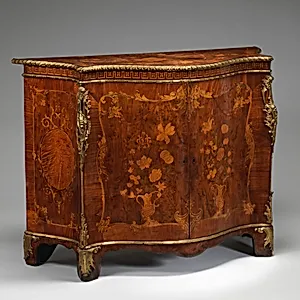
Commode
ca. 1760–70
Medium
Pine veneered with satinwood, mahogany, burl, yew, and purplewood; gilt bronze
Dimensions
Overall: 36 7/8 × 49 3/4 × 21 1/4 in. (93.7 × 126.4 × 54 cm)
Classification
Woodwork-Furniture
Culture
British
Department
European Sculpture and Decorative Arts
Museum
Metropolitan Museum of Art, New York, NY
Credit
Fletcher Fund, 1959
Accession Number
59.8
Rights
Public Domain
Tags
Art Historical Context
This elegant commode, crafted around 1760–70 by the renowned London cabinetmakers John Mayhew and William In, exemplifies the refined neoclassical style of mid-Georgian Britain. Partners in the prestigious firm Ince and Mayhew, they were celebrated for their innovative designs, influenced by the emerging taste for symmetry and classical motifs inspired by ancient Greece and Rome. Published patterns in their 1762 book *The Universal System of Household* helped popularize such pieces among the aristocracy, making this commode a hallmark of sophisticated 18th-century domestic luxury. Constructed from pine veneered with satinwood, mahogany, burl, yew, and purplewood, the piece showcases masterful wood veneering—a technique where thin slices of exotic woods are glued to a sturdy base to create intricate patterns and shimmering effects. Gilt bronze mounts add a touch of opulence, likely featuring floral motifs that evoke the era's love for nature-inspired ornamentation. Measuring nearly four feet wide, it would have anchored a grand drawing room, serving both as storage and a statement of wealth. Housed in The Metropolitan Museum of Art's European Sculpture and Decorative Arts collection (acquired via the Fletcher Fund in 1959), this British masterpiece highlights how furniture became an art form, blending functionality with breathtaking craftsmanship during a golden age of design.
About the Artist
John Mayhew|William Ince (British|British) · 1736 |1704 –1811 |1804
British, 1736–1811|British, active ca. 1758/59–1794, died 1804