
Commode
ca. 1740–45
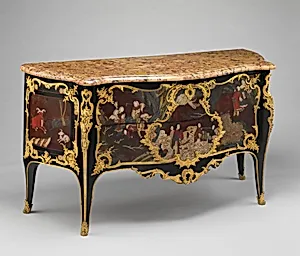
Medium
Oak veneered with panels of Chinese Coromandel lacquer and European black-lacquered veneer; gilt-bronze mounts; brèche d'Alep marble top
Dimensions
34 x 63 x 25 1/4 in. (86.4 x 160 x 64.1 cm)
Classification
Woodwork-Furniture
Culture
French, Paris
Department
European Sculpture and Decorative Arts
Museum
Metropolitan Museum of Art, New York, NY
Credit
The Lesley and Emma Sheafer Collection, Bequest of Emma A. Sheafer, 1973
Accession Number
1974.356.189
Rights
Public Domain
Tags
Art Historical Context
This exquisite commode, crafted by the renowned Parisian cabinetmaker Bernard van Risenburgh around 1740–45, exemplifies the opulent Rococo style of Louis XV-era France. Van Risenburgh, celebrated for his mastery of exotic materials, created this chest of drawers as a luxurious of furniture, blending functionality with grandeur. Measuring 34 x 63 x 25¼ inches, it served as a status symbol in aristocratic interiors, where such commodes held linens, silver, or valuables while dazzling with their decorative flair. The commode's construction highlights innovative 18th-century techniques: a sturdy oak core veneered with rare panels of Chinese Coromandel lacquer—thick, incised, and filled with pigments from screens imported via trade routes—and contrasting European black-lacquered (japanned) grounds. Ornate gilt-bronze mounts, likely depicting animals, men, and women from the lacquer motifs, frame the panels with scrolling foliage and mythical figures, adding rhythmic movement. The brèche d'Alep marble top, with its dramatic veining, provided a sumptuous surface resistant to stains. Housed in The Metropolitan Museum of Art's European Sculpture and Decorative Arts Department (The Lesley and Emma Sheafer Collection, 1973), this piece reflects the era's Chinoiserie craze, merging Eastern artistry with French ébénisterie to symbolize wealth and cosmopolitan taste. A true jewel of the Enlightenment's decorative arts.