
Commode (Secrétaire à abattant)
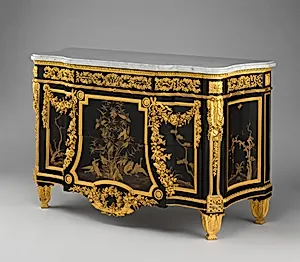
Medium
Oak veneered with ebony and 17th-century Japanese lacquer; interiors veneered with tulipwood, amaranth, holly, and ebonized holly; gilt-bronze mounts; marble top; velvet (not original)
Dimensions
H. 36-3/4 x W. 56-1/2 x D. 23-1/2 in. (93.3 x 143.5 x 59.7 cm)
Classification
Woodwork-Furniture
Culture
French, Paris
Department
European Sculpture and Decorative Arts
Museum
Metropolitan Museum of Art, New York, NY
Credit
Bequest of William K. Vanderbilt, 1920
Accession Number
20.155.12
Rights
Public Domain
Art Historical Context
This exquisite *Commode (Secrétaire abattant)* by Jean Henri Riesener, in Paris in 1783, the pinnacle of Louis XVI-era French cabinetmaking. Riesener, the royal ébéniste to Louis XVI and Marie Antoinette, was renowned for his mastery of Neoclassical furniture, blending symmetry, refinement, and opulent materials. This piece served dual purposes as both a stately chest of drawers and a drop-front writing desk, reflecting the era's demand for multifunctional luxury furnishings among the aristocracy. The commode's oak carcass is veneered in ebony and rare 17th-century Japanese lacquer panels—highly prized imports that evoke exotic allure amid Europe's chinoiserie craze. Delicate interiors feature marquetry in tulipwood, amaranth, holly, and ebonized holly, adorned with motifs of garlands, birds, flowers, and plants. Gilt-bronze mounts add neoclassical flourish, while the marble top and (later-added) velvet lining enhance its grandeur. At 36-3/4 x 56-1/2 x 23-1/2 inches, it commanded presence in grand salons. Bequeathed to the Metropolitan Museum of Art by William K. Vanderbilt in 1920, this commode highlights transatlantic appreciation for French decorative arts, preserving a snapshot of pre-Revolutionary opulence. Visitors, imagine Marie Antoinette's court admiring its intricate beauty!