
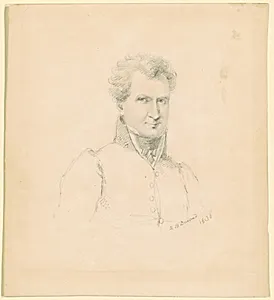
Commodore John Barry
Medium
graphite on wove paper
Dimensions
image (irregular): 8.57 × 8.26 cm (3 3/8 × 3 1/4 in.) sheet: 15.88 × 14.45 cm (6 1/4 × 5 11/16 in.)
Classification
Drawing
Department
CG-W
Museum
National Gallery of Art, Washington, D.C.
Credit
Corcoran Collection (Museum Purchase, Membership Association Fund)
Accession Number
2015.19.751
Rights
Public Domain
Art Historical Context
Behold *Commodore John Barry*, a delicate graphite drawing by Asher B. Durand from 1830, now housed in the National Gallery of Art as part of the Corcoran Collection. This intimate portrait captures the likeness of John Barry, the Irish-born naval hero revered as the "Father of American Navy" for his daring exploits during the Revolutionary War, including commanding the first U.S. naval vessel authorized by Congress. Created on smooth wove paper—a favored support for precise pencil work in the early 19th century—Durand's modest 3⅜ × 3¼-inch image (irregularly shaped on a larger 6¼ × 5⅞-inch sheet) exemplifies the artist's early mastery of graphite. Durand, who later became a pillar of the Hudson River School with his luminous landscapes, began his career as an engraver, honing a meticulous line quality evident here in the subtle modeling of Barry's face and uniform. This drawing likely served as a study or preliminary sketch, reflecting the era's growing interest in commemorating national figures amid rising American patriotism. Its cultural significance lies in preserving Barry's stern yet resolute gaze, a testament to the revolutionary legacy just decades after independence. Visitors will appreciate how Durand's economical technique distills heroism into everyday intimacy, bridging portraiture and the fine arts tradition.
About the Artist
Asher Brown Durand · 1796–1886
Was a principal member of the Hudson River School. American artist; associated with the Hudson River School of landscape painting. Comment on works: Portraits