
Compartmented stamp seal
Unknown Artist
ca. late 3rd–early 2nd millennium BCE
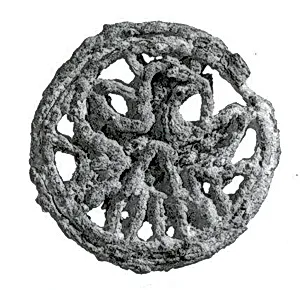
Medium
Copper alloy
Dimensions
0.47 in. (1.19 cm)
Classification
Metalwork-Stamp Seals
Culture & Period
Bactria-Margiana Archaeological Complex · Bronze Age
Department
Ancient Near Eastern Art
Museum
Metropolitan Museum of Art, New York, NY
Credit
Purchase, Mary C. Reed, Mrs. Peter Oliver and Mrs. Vladimir Littauer Gifts, 1978
Accession Number
1978.261.3
Rights
Public Domain
Art Historical Context
This diminutive copper alloy stamp seal, measuring just 0.47 inches (1.19 cm), hails from the Bactria-Margiana Archaeological Complex (BMAC)—a enigmatic Bronze Age culture flourishing in Central Asia around the late 3rd to early 2nd millennium BCE. Discovered in regions spanning modern-day Uzbekistan, Turkmenistan, and northern Afghanistan, BMAC societies built sophisticated urban centers like Gonur Tepe, blending influences from Mesopotamia, Iran, and the Indus Valley. These compartmentalized seals, with their intricate divided designs, were essential tools for administration, used to imprint clay for sealing goods, doors, or documents, signifying ownership and authority. Crafted from copper alloy, the seal exemplifies early metallurgical prowess in the Bronze Age, where alloys of copper and tin enabled durable, finely detailed objects. The "compartmented" style—featuring segmented motifs—reflects a distinctive BMAC aesthetic, possibly depicting animals, symbols, or geometric patterns that held ritual or protective significance. Though tiny, its precision highlights advanced stamping techniques, allowing for repeatable impressions that supported complex trade networks. Now at the Metropolitan Museum of Art (purchased in 1978), this artifact offers a window into a mysterious civilization that bridged East and West, reminding us how small objects illuminate vast ancient worlds.