
Compartmented stamp seal
Unknown Artist
ca. late 3rd–early 2nd millennium BCE
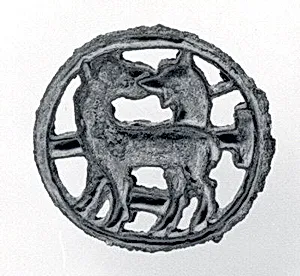
Medium
Copper alloy
Dimensions
1 5/8 in. (4.1 cm)
Classification
Metalwork-Stamp Seals
Culture & Period
Bactria-Margiana Archaeological Complex · Bronze Age
Department
Ancient Near Eastern Art
Museum
Metropolitan Museum of Art, New York, NY
Credit
Purchase, David L. Klein Jr. Memorial Foundation Inc. Gift, 1984
Accession Number
1984.3
Rights
Public Domain
Tags
Art Historical Context
This petite copper alloy stamp seal, hailing from the Bactria-Margiana Complex (BMAC)— enigmatic Bronze Age culture flourishing in Central Asia around modern-day Uzbekistan, Turkmenistan, northern Afghanistan—dates to the late 3rd or early 2nd millennium. Measuring just 1 5/8 inches (4.1 cm), its compact form belies its practical power: designed to press intricate designs into soft clay, it served as an ancient security device for sealing goods, doors, or documents in bustling trade networks linking Mesopotamia, Iran, and the Indus Valley. The seal's "compartmented" design, a hallmark of BMAC artistry, divides its surface into distinct sections likely featuring animal motifs—a tag that hints at the culture's fascination with wildlife, perhaps symbolizing power, fertility, or protective spirits. Crafted from durable copper alloy, it showcases advanced Bronze Age metalworking techniques, including casting and engraving, which allowed for finely detailed impressions. These seals were status symbols for elites, reflecting a sophisticated society of fortified cities like Gonur Tepe, where art and administration intertwined. Today, this artifact invites us to ponder the daily lives of BMAC's people, whose civilization mysteriously declined around 1700 BCE. On view in the Metropolitan Museum of Art's Ancient Near Eastern Art department, it was acquired through the David L. Klein Jr. Memorial Foundation Inc. Gift in 1984—a tiny window into a lost world.