
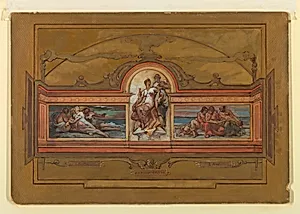
Competitive Design for a Mural in the United States Court House, New York
Medium
mural designs
Classification
mural designs
Department
Smithsonian Collection
Museum
Smithsonian American Art Museum
Credit
Gift of Mrs. Walter Shirlaw
Accession Number
1912-16-82
Rights
Public Domain
About this artwork
Research in Progress
Art Historical Context
Walter Shirlaw’s “Competitive Design for a Mural in the United States Court House, New York” (ca. 1895) captures a moment when American artists were invited to bring grand, symbolic imagery into the nation’s newly built federal spaces. Born in Scotland in 1838 and raised in the United States, Shirlaw became one of the country’s early advocates for large-scale mural painting, helping to shape a distinctly American approach to public decoration during the Gilded Age. Mural designs like this one were created for competitive commissions that adorned courthouses, libraries, and capitols across the country. They were meant to convey ideals of justice, civic virtue, and national progress to everyday visitors. Although the precise imagery of Shirlaw’s proposal remains under study, the work itself reflects the period’s belief that art could elevate public architecture and foster a shared sense of American identity. Now part of the Smithsonian American Art Museum’s collection, the design was generously given by the artist’s widow. It offers today’s visitors a glimpse into the creative process behind the murals that still grace many historic government buildings.