
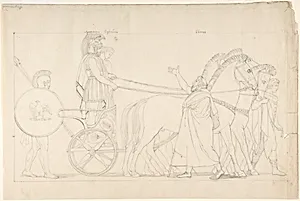
Composition from the Tragedies of Aeschylus, plate 17 (recto); Goddess Statue from the Suppliants, plate 7 (verso)
19th century
Medium
Graphite
Dimensions
Sheet: 10 3/8 × 15 11/16 in. (26.3 × 39.8 cm)
Classification
Drawings
Department
Drawings and Prints
Museum
Metropolitan Museum of Art, New York, NY
Credit
Museum Accession
Accession Number
X.816
Rights
Public Domain
Tags
Art Historical Context
John Flaxman's *Composition from the Traged of Aeschylus, 17 (recto); Goddess Statue from the Supants, plate 7 (verso)* is a double-sided graphite drawing from the 19 century, now housed in the Metropolitan Museum Art's Department of Drawings and Prints. the recto, Flaxman sketches a dynamic scene likely evoking the ancient Greek tragedies of Aeschylus, featuring, horses, and chari in fluid, linear compositions that pulse with dramatic tension. The verso presents a serene goddess statue from *The Suppliants*, one of Aeschylus's earliest surviving plays, where the daughters of Danaus plead for sanctuary. As a leading figure in Neoclassicism, Flaxman (1755–1826) was renowned for his precise, outline-style illustrations inspired by ancient Greek vase painting and sculpture. These graphite works, measuring 10 3/8 × 15 11/16 inches, served as preparatory designs for his influential book engravings, bridging classical antiquity with Regency-era audiences. His economical use of graphite highlights pure form and narrative clarity, making complex myths accessible and timeless. This sheet exemplifies Flaxman's role in reviving Aeschylus's profound themes of fate, piety, and heroism, offering visitors a window into how 19th-century artists reimagined ancient drama through elegant draughtsmanship.
About the Artist
John Flaxman · 1755–1826
John Flaxman (1755–1826) was born in York, England, the son of John Flaxman Sr., a moulder and seller of plaster casts who ran a studio in London's Covent Garden. Largely self-taught amid his father's stock of classical casts, with minimal formal schooling due to childhood illness, Flaxman displayed prodigious talent early on. At age 12, he won a Society of Arts prize for a medallion; by 15, anoth...