
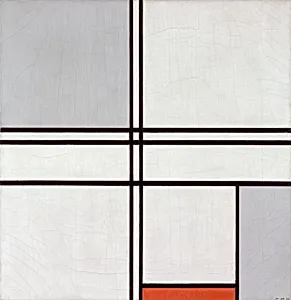
Composition (No. 1) Gray-Red
1935
Medium
Oil on canvas
Dimensions
57.5 × 55.6 cm (22 5/8 × 21 7/8 in.)
Classification
painting
Department
Modern Art
Museum
Art Institute of Chicago
Accession Number
65821
Rights
Public Domain
About this artwork
The roots of 20th-century abstract art can be traced to the late 19th century, when artists began to move away from the direct representation of objects toward the communication of emotional states or moods. In doing so, the formal properties of art—such visual elements as line, color, and composition—assumed a primary role in its production. After World War I, many artists, including Piet Mondrian, believed that abstract art could contribute to a more harmonious society by communicating in a un...
Art Historical Context
Piet Mondrian's *Composition (No. 1) Gray-Red* (1935) exemplifies the Dutch artist's revolutionary approach to abstraction. Painted in oil on canvas, this compact work measures 57.5 × 55.6 cm and belongs to the Art Institute of Chicago's Modern Art collection. Mondrian, a pioneer of the De Stijl movement, sought to distill art to its purest essence through geometric forms, horizontal and vertical black lines, and planes of color—here, dominated by subtle grays and reds rather than his signature primaries. Created during Mondrian's Paris years amid the rise of European modernism, the painting reflects his Neoplasticist philosophy: universal harmony achieved by balancing asymmetry and rhythm. Unlike representational art, it invites viewers to experience pure visual equilibrium, influenced by his earlier Cubist explorations and theosophical beliefs in spiritual order. This piece captures Mondrian's late evolution, where muted tones add emotional depth to his grid-based compositions. A cornerstone of 20th-century abstraction, it underscores how everyday canvas became a portal to cosmic balance, inspiring generations from architects to graphic designers.
About the Artist
Piet Mondrian · 1872–1944
**Piet Mondrian** (born Pieter Cornelis Mondriaan, 7 March 1872 – 1 February 1944) was a Dutch painter and theoretician who became one of the most influential figures in 20th-century abstract art. Born in Amersfoort, Netherlands, as the second of his parents’ children, he grew up in a creative household; his father was a qualified drawing teacher and headmaster, while his uncle, Frits Mondriaan, a...