
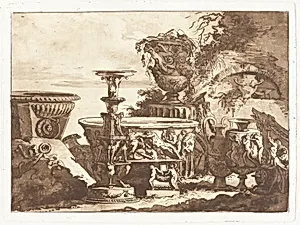
Composition with Antique Vases
Medium
etching, aquatint, and lift-ground aquatint printed in brown on laid paper
Dimensions
plate: 21.8 × 29.1 cm (8 9/16 × 11 7/16 in.) sheet: 44 × 59.5 cm (17 5/16 × 23 7/16 in.)
Classification
Department
CG-E
Museum
National Gallery of Art, Washington, D.C.
Credit
Pepita Milmore Memorial Fund
Accession Number
2018.91.38
Rights
Public Domain
Art Historical Context
**Composition with Antique Vases**1782) is a captivating print by French artist Jean-Jacques Lagrenée II (9–1804), a master of Rococo elegance who bridged into Neoclassicism. Created through etching, aquatint and innovative lift-ground aquatint, then printed in warm brown ink on laid paper, this measures a modest plate size of 21.8 × 29.1 cm. Housed in the National Gallery Art's print collection, it exemplifies the refined printmaking of late 18th-century France where artists like Lagrenée drew inspiration from classical antiquity amid the Enlightenment's revival of ancient forms. The composition likely arranges ornate antique vases—echoes of Greco-Roman treasures—in a harmonious still life, reflecting the era's passion for archaeological discoveries and the Grand Tour. Lagrenée, trained at the Académie Royale and influenced by his brother Louis-Jean-François, used these vases to evoke timeless beauty and scholarly sophistication, popular among Europe's elite collectors just before the French Revolution. What sets this print apart are its advanced techniques: aquatint produces velvety tones mimicking wash drawings, while lift-ground aquatint (using sugar-lift for painterly dissolves) adds subtle textures and depth, pushing printmaking toward painting-like realism. A testament to technical virtuosity, it invites visitors to appreciate how 1780s innovations captured the neoclassical ideal of measured grace on paper. (198 words)