
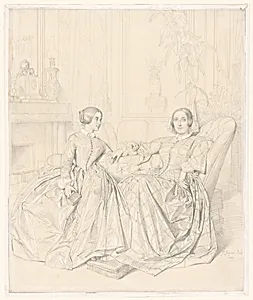
Comtesse Charles d’Agoult (born Marie de Flavigny) and Her Daughter Claire d’Agoult
Medium
Graphite, heightened with white opaque watercolor, with touches of yellow watercolor, on off-white wove paper, lined to secondary wove paper
Dimensions
Primary support: 48.5 × 39.9 cm (19 1/8 × 15 3/4 in.); Secondary support: 49.9 × 41.5 cm (19 11/16 × 16 3/8 in.)
Classification
drawings (visual works)
Department
Prints and Drawings
Museum
Art Institute of Chicago
Accession Number
244917
Rights
Public Domain
About this artwork
One of Jean-Auguste-Dominique Ingres’s largest and most ambitious portrait drawings, this work depicts the important Parisian society hostess, writer, and critic the Comtesse Marie d’Agoult and her daughter Claire. Ingres typically produced his portrait drawings without preparation and in a single sitting. This work, in contrast, required at least two sittings and three preparatory studies. The drawing is notable for its evocation of the richly furnished interior of d’Agoult’s home. The artist ...
Art Historical Context
In the Prints and Drawings department of the Art Institute of Chicago, Jean Auguste Dominique Ingres’ *Comtesse Charles d’Agoult (born Marie de Flavigny) and Her Daughter Claire d’Agoult* (1849) offers a poignant glimpse into mid-19th-century French society. Ingres, a leading Neoclassicist renowned for his meticulous draftsmanship, captures the noblewoman— a prominent salonnière and author—and her young daughter in an intimate double portrait. Created during a time of political upheaval in France’s Second Republic, the drawing reflects the era’s emphasis on refined portraiture among the aristocracy. Executed on off-white wove paper (48.5 × 39.9 cm), this preparatory-style sheet showcases Ingres’ virtuoso technique: fluid graphite lines heightened with white opaque watercolor and subtle yellow touches for luminous highlights. The layered media create a sculptural depth and ethereal glow, hallmarks of Ingres’ drawings, which often rivaled his paintings in precision and emotional resonance. Lined to a secondary support for preservation, it exemplifies the fragility and artistry of works on paper. This piece highlights Ingres’ enduring legacy in bridging Neoclassicism with Romantic sensibilities, inviting viewers to appreciate the tender maternal bond amid technical mastery. A gem for drawing enthusiasts, it underscores how such sketches preserved the likenesses of cultural figures like the Comtesse.
About the Artist
Jean Auguste Dominique Ingres · 1780–1867
Jean-Auguste-Dominique Ingres was born on 29 August 1780 in Montauban, in the Tarn-et-Garonne region of southern France, into a family with deep artistic and musical connections — his father was a painter, sculptor, and musician. He showed exceptional promise from childhood, enrolling at the Académie Royale in Toulouse where he studied under the sculptor Jean-Pierre Vigan, the landscape painter Je...