
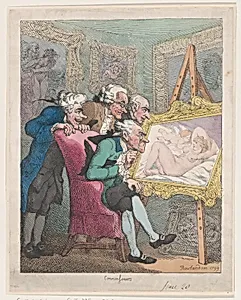
Connoisseurs
June 20, 1799
Medium
Hand-colored etching
Dimensions
Sheet: 10 11/16 × 8 7/16 in. (27.2 × 21.4 cm)
Classification
Prints
Department
Drawings and Prints
Museum
Metropolitan Museum of Art, New York, NY
Credit
The Elisha Whittelsey Collection, The Elisha Whittelsey Fund, 1959
Accession Number
59.533.644
Rights
Public Domain
Tags
Art Historical Context
Thomas Rowlandson's *Connoisseurs*, published on June 20, 1799, by S.W. Fores, is a delightful hand-colored etching that captures the satirical spirit of late Georgian Britain. Measuring 10 11/16 × 8 7/16 inches, this print belongs to the Metropolitan Museum of Art's Elisha Whittelsey Collection. Rowlandson, a renowned English caricaturist, was celebrated for his witty, often irreverent depictions of society, blending sharp social commentary with lively humor during the golden age of British satire. The title *Connoisseurs* and tags—men, Cupid, and Venus—suggest a playful jab at self-proclaimed art experts scrutinizing classical subjects like the goddess of love and her mischievous son. Hand-coloring, a meticulous technique applied after printing, brings vibrant life to the etching, enhancing its appeal as an affordable yet collectible art form for the emerging middle class. This medium was pivotal in disseminating satire, allowing prints to mock the pretensions of the art world and high society. Rowlandson's work reflects the cultural fervor for antiquities and neoclassicism in 1790s London, while poking fun at connoisseurship's excesses. A charming window into Regency-era wit, it invites visitors to chuckle at the timeless folly of art appreciation.
About the Artist
Thomas Rowlandson|S. W. Fores · 1756–1827
Thomas Rowlandson (1757–1827) was an English artist and caricaturist whose satirical watercolors and prints captured the social life of Georgian Britain with unparalleled wit and technical mastery. Alongside James Gillray, he is recognized as one of the greatest British graphic artists, and his distinctive flowing line and keen observations have made his work integral to understanding late 18th an...