
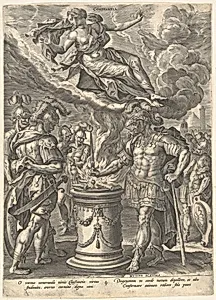
Constantia, from "Virtues"
ca. 1581
Medium
Engraving
Dimensions
Sheet: 11 3/8 x 8 1/4 in. (28.9 x 21 cm)
Classification
Prints
Department
Drawings and Prints
Museum
Metropolitan Museum of Art, New York, NY
Credit
The Elisha Whittelsey Collection, The Elisha Whittelsey Fund, 1949
Accession Number
49.95.1994
Rights
Public Domain
Tags
Art Historical Context
"Constantia, from 'Virtues'" is a engraving by the Flemish artist Maerten de Vos, created around 1581. De Vos, a prominent Antwerp Mannerist known for his intricate allegorical and religious works, contributed to the vibrant print culture of the late Northern Renaissance. This piece personifies *Constantia*—the virtue of steadfastness or perseverance—amid a dramatic scene featuring female nudes, armored men, and weapons, evoking resilience in the face of adversity. Produced during a turbulent era of religious strife in the Spanish Netherlands, such prints promoted moral and Christian ideals as part of the Counter-Reformation. As an engraving on a modest sheet (11 3/8 x 8 1/4 in.), the work showcases the precision of the burin technique, allowing fine lines to convey dynamic poses, rich textures, and symbolic details. Prints like this were revolutionary for their reproducibility, disseminating de Vos's designs across Europe to educate and inspire lay audiences beyond elite patrons. Housed in the Metropolitan Museum of Art's Drawings and Prints department (The Elisha Whittelsey Collection, 1949), *Constantia* exemplifies how 16th-century artists blended classical mythology with Christian virtue, offering timeless lessons on inner strength. Visitors will appreciate its blend of sensuality and symbolism, a window into Renaissance moral artistry.