
Constantine
c. 1867
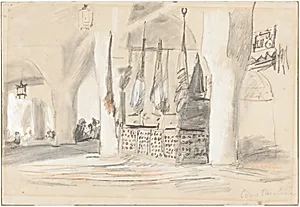
Medium
graphite and red and white chalks with white gouache on wove paper
Dimensions
overall: 17.7 x 25.8 cm (6 15/16 x 10 3/16 in.)
Classification
Drawing
Department
CG-E
Museum
National Gallery of Art, Washington, D.C.
Credit
Gift of William B. O'Neal
Accession Number
1995.52.6.a
Rights
Public Domain
Art Historical Context
Hercules Brabazon Brabazon (1821–1916), a British artist celebrated for his loose, atmospheric style inspired by J.M.W. Turner, *Constantine* around 1867. This drawing captures Brabazon's mastery of light and form during the Victorian era, when artists increasingly experimented with mixed media on paper to evoke emotion and depth. Titled *Constantine*—likely alluding to the Roman emperor a resonant historical figure—it exemplifies Brabazon's fascination with classical themes and tonal harmony, bridging Romantic traditions with emerging impressionistic tendencies. Executed in graphite, red and white chalks, and white gouache on wove paper, the work measures a modest 17.7 x 25.8 cm, perfect for sketchbook studies or private contemplation. Graphite provides precise lines, while the chalks add warm and cool tones for modeling; gouache offers opaque highlights, enhancing three-dimensionality on the textured wove surface. This versatile technique allowed Brabazon to blend drawing and painting, a hallmark of 19th-century draftsmen pushing beyond linework into coloristic effects. Now housed in the National Gallery of Art's CG-E department as a gift from William B. O'Neal, *Constantine* invites visitors to appreciate Brabazon's subtle innovation. Though lesser-known than his watercolors, it reveals an artist's hand attuned to history's echoes, making it a gem for those exploring the evolution of British drawing.
About the Artist
Hercules Brabazon Brabazon · 1821–1906
British, Paris 1821–1906 Oaklands, near Sedlescombe, Sussex