
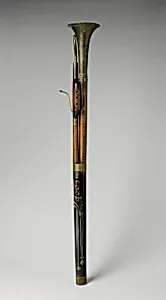
Contrabassoon in C
1825–33
Medium
Maple, brass
Dimensions
162cm x 22cm x 22cm
Classification
Aerophone-Reed Vibrated-double reed
Culture
Austrian
Department
Musical Instruments
Museum
Metropolitan Museum of Art, New York, NY
Credit
The Crosby Brown Collection of Musical Instruments, 1889
Accession Number
89.4.1736
Rights
Public Domain
Art Historical Context
This striking contrabassoon in C was crafted by Johann Tobias Uhlmann, an esteemed Austrian instrument maker, between 1825 and 1833. Standing over five feet tall, the instrument belongs to the double-reed aerophone family and was designed to deliver the orchestra’s deepest, most resonant bass tones. Its substantial maple body, accented with brass fittings, reflects the sturdy construction favored in early-nineteenth-century Vienna, where expanding Romantic orchestras sought richer low-register color. Uhlmann’s design exemplifies the technical refinements occurring in woodwind making during this period. The use of dense maple ensured both durability and a warm, focused tone, while the brass keys allowed for improved intonation and easier playability across the instrument’s extended range. Such instruments were essential in large-scale symphonic works, providing harmonic foundation beneath the standard bassoon section. Acquired in 1889 as part of the Crosby Brown Collection, this contrabassoon now resides in the Metropolitan Museum’s Department of Musical Instruments, offering visitors a tangible link to the evolving soundscape of nineteenth-century European music.