
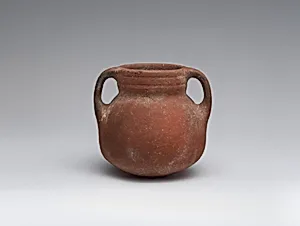
Cooking pot
Unknown Artist
ca. late 8th–7th century BCE
Medium
Ceramic
Dimensions
4 3/16 × 5 3/16 in. (10.6 × 13.2 cm)
Classification
Ceramics-Vessels
Culture & Period
Israelite · Iron Age II
Department
Ancient Near Eastern Art
Museum
Metropolitan Museum of Art, New York, NY
Credit
Gift of Harris D. and H. Dunscombe Colt, 1934
Accession Number
34.126.43
Rights
Public Domain
Art Historical Context
This unassuming cooking pot, crafted by an unknown Israelite artisan around the late 8th to 7th century BCE offers a tangible window into the daily life of Iron Age II in ancient Israel. Measuring just 4 3/16 × 5 3/16 inches (10.6 × 13.2 cm), this ceramic vessel was designed for practical use over an open fire, reflecting the modest yet essential tools of a agrarian society during the time of the divided kingdoms of and Judah. As a product of Iron Age pottery traditions in the Ancient Near East, it exemplifies the era's utilitarian ceramics, likely wheel-thrown and fired to withstand heat. Such pots were ubiquitous in domestic settings, used for simmering stews of lentils, grains, and vegetables—foods central to biblical-era diets. Its presence in the Metropolitan Museum of Art, a gift from Harris D. and H. Dunscombe Colt in 1934, underscores how everyday objects illuminate cultural routines, far beyond grand monuments. Though simple, this pot speaks volumes about Israelite ingenuity and resilience amid geopolitical upheavals, like Assyrian incursions. It invites us to ponder the hands that shaped it, connecting us to the rhythms of ancient hearths.