
Copper Disk Ornament
Unknown Artist
3rd century BCE–2nd century CE
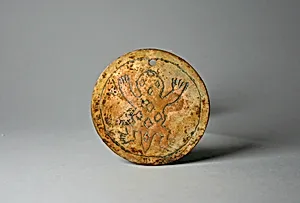
Medium
Copper, gilt
Dimensions
Diameter 3-5/16 in. (8.4 cm)
Classification
Metal-Ornaments
Culture
Vicús (?)
Department
Arts of Africa, Oceania, and the Americas
Museum
Metropolitan Museum of Art, New York, NY
Credit
Bequest of Jane Costello Goldberg, from the Collection of Arnold I. Goldberg, 1986
Accession Number
1987.394.172
Rights
Public Domain
Tags
Art Historical Context
This delicate **Copper Disk Ornament**, from the 3rd century to the 2nd CE, hails from the ancient Vicús culture (or a closely related group) on Peru's northern coast. just 3-5/16 inches (8.4 cm) in diameter, was crafted from copper and enhanced with gilding—a technique that applied a thin layer of gold to create a shimmering, luxurious surface. Now housed in the Metropolitan Museum of Art's of Arts of Africa,, and the Americas, entered the collection through the 1986 bequest of Jane Costello Goldberg from her husband Arnold I. Goldberg's esteemed holdings. The Vicús people were renowned pre-Columbian metalworkers, producing intricate ornaments like this disk, likely worn as earrings, pectorals, or ceremonial adornments. Its animal motifs—evident from thematic tags—reflect Andean traditions where creatures symbolized fertility, protection, or supernatural forces, blending everyday life with cosmology. Hammering thin copper sheets and gilding them demonstrated advanced technical prowess, rivaling later Inca metallurgy and underscoring early innovations in the Americas. As a small yet striking artifact, this piece illuminates the Vicús' vibrant material culture during a formative era of regional trade and ritual artistry, offering visitors a tangible link to Peru's ancient past.