
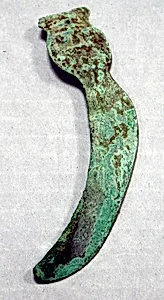
Copper Knife
Unknown Artist
before 15th century
Medium
Copper (hammered)
Dimensions
Length 4-7/8 in. (12.5 cm)
Classification
Metal-Implements
Culture
Peruvian
Department
Arts of Africa, Oceania, and the Americas
Museum
Metropolitan Museum of Art, New York, NY
Credit
Bequest of Jane Costello Goldberg, from the Collection of Arnold I. Goldberg, 1986
Accession Number
1987.394.615
Rights
Public Domain
Art Historical Context
This slender copper knife, forged by an unknown Peruvian artisan before the 15th century exemplifies the ingenuity of pre-Columbian metalworking in the Andes. Measuring just 4-7/8 inches (12.5 cm) in length, its hammered copper blade and handle reveal a masterful cold-working technique: artisans shaped raw or smelted copper sheets through repeated hammering, annealing, and polishing, without the aid of molds or advanced alloys. This labor-intensive process produced a functional yet elegantly proportioned tool, ideal for everyday tasks like cutting or skinning. In ancient Peruvian cultures—spanning horizons from Chavín to Chimú—such metal implements held both practical and symbolic value. Copper, abundant in Andean mines, marked one of the earliest metallurgical traditions in the Americas, emerging around 1000 BCE. Knives like this might have served in rituals, warfare, or elite feasting, reflecting social hierarchies where metal mastery signaled prestige. Today, this artifact from the Metropolitan Museum of Art's Arts of Africa, Oceania, and the Americas collection (bequest of Jane Costello Goldberg, 1986) invites us to marvel at Peru's pre-Inca ingenuity, bridging utility and artistry in a compact form.