
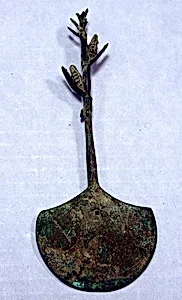
Copper Ornament with Corn Stalk Top
Unknown Artist
before 16th century
Medium
Copper
Dimensions
Length 3-1/16 in. (7.7 cm)
Classification
Metal-Ornaments
Culture
Peruvian
Department
Arts of Africa, Oceania, and the Americas
Museum
Metropolitan Museum of Art, New York, NY
Credit
Bequest of Jane Costello Goldberg, from the Collection of Arnold I. Goldberg, 1986
Accession Number
1987.394.290
Rights
Public Domain
Art Historical Context
This delicate copper ornament, featuring a stalk at its top, hails from ancient Peru before the 16th, a time when sophisticated Andean cultures thrived long before European contact. Measuring just 3-1/16 inches (7.7 cm) in length, small metal adornment likely served as personal jewelry—perhaps an ear or nose ornament—reflecting the daily lives and spiritual beliefs of its makers. Crafted from copper, a metal that pre-Columbian Peruvi mastered through hammering and possibly lost-wax casting, it showcases their advanced metallurgical skills, which produced everything from tools to ceremonial objects. The corn stalk motif is particularly evocative, as maize was a sacred staple crop in Andean societies, symbolizing fertility, sustenance, and the earth's bounty. Such ornaments underscore the deep cultural reverence for agriculture, integral to rituals and social status. Displayed in the Metropolitan Museum of Art's Department of the Arts of Africa, Oceania, and the Americas, this piece—bequeathed by Jane Costello Goldberg from the Collection of Arnold I. Goldberg in 1986—offers a tangible link to Peru's pre-Hispanic heritage, inviting us to ponder the ingenuity of unnamed artisans who wove nature's rhythms into wearable art.