
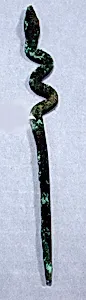
Copper Pin
Unknown Artist
before 16th century
Medium
Copper (cast)
Dimensions
Length 6-15/16 in. (17.6 cm)
Classification
Metal-Implements
Culture
Peruvian
Department
Arts of Africa, Oceania, and the Americas
Museum
Metropolitan Museum of Art, New York, NY
Credit
Bequest of Jane Costello Goldberg, from the Collection of Arnold I. Goldberg, 1986
Accession Number
1987.394.304
Rights
Public Domain
Tags
Art Historical Context
This elegant Copper Pin, crafted by an unknown Peruvian artist before the16th century, exemplifies sophisticated metalworking of pre-Columbian Andean. Measuring 6-15/16 inches (17.6 cm) in length, it was cast from copper—a medium that highlights the region's advanced lost-wax casting techniques, allowing for intricate forms and durability. Housed in the Metropolitan Museum of Art's Department of Arts of Africa,, and the Americas, metal implement was generously bequeathed by Jane Costello Goldberg the collection of Arnold I. Goldberg in 1986. In ancient Peru, such pins likely served practical yet symbolic purposes, fastening garments while conveying cultural motifs. The prominent snake imagery, a recurring tag for this piece, evokes the serpent's profound role in Andean cosmology—often symbolizing fertility, renewal, and underworld connections in cultures like the Moche, Chimú, or Inca predecessors. These designs transformed everyday objects into talismans, blending utility with spiritual significance. As a testament to Peru's pre-Hispanic ingenuity, this pin invites us to marvel at how ancient artisans fused artistry with everyday life, their enduring copper forms whispering stories of a vibrant, snake-entwined world long before European contact.