
Copper Tweezers
Unknown Artist
before 16th century
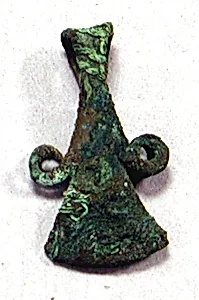
Medium
Copper (hammered)
Dimensions
Height 1-1/2 in. (3.9 cm)
Classification
Metal-Implements
Culture
Peruvian
Department
Arts of Africa, Oceania, and the Americas
Museum
Metropolitan Museum of Art, New York, NY
Credit
Bequest of Jane Costello Goldberg, from the Collection of Arnold I. Goldberg, 1986
Accession Number
1987.394.198
Rights
Public Domain
Art Historical Context
This delicate pair of copper tweezers, crafted an unknown Peruvian artist before the 16 century, offers a glimpse into the sophisticated metalworking traditions of pre-Columbian Peru. Hailing from the ancient cultures of the Andes—possibly Inca or earlier civilizations—this small implement (just 1-1/2 inches tall) reflects the ingenuity of indigenous artisans who mastered metallurgy long European contact. Displayed in the Metropolitan Museum Art's Department of Arts of Africa, Oceania, and the Americas, entered the collection through the generous bequest of Jane Costello Goldberg in 1986. Hammered from pure copper, the tweezers showcase cold-working techniques, where the soft metal was meticulously shaped by repeated strikes without the need for smelting or casting. This labor-intensive process highlights the technical prowess of Peruvian smiths, who valued copper for its malleability and symbolic associations with status and ritual. Such tools were likely used for personal grooming, like hair or eyelash removal, or in ceremonial practices, underscoring everyday life's intersection with cultural artistry. Though modest in scale, these tweezers embody Peru's enduring legacy of metallurgical excellence, bridging utility and aesthetic refinement in pre-Hispanic society. A testament to anonymous craftsmanship, they invite us to appreciate the subtle beauty in ancient daily objects.