
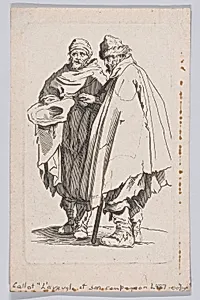
Copy of L'Aveugle et son Compagnon (The Blind Man and his Companion), from "Les Gueux suite appelée aussi Les Mendiants, Les Baroni, ou Les Barons" (The Beggars, also called the Barons)
17th century
Medium
Etching
Dimensions
Sheet: 6 9/16 x 4 1/8 in. (16.6 x 10.5 cm) Plate: 5 1/2 x 3 3/8 in. (14 x 8.6 cm)
Classification
Prints
Department
Drawings and Prints
Museum
Metropolitan Museum of Art, New York, NY
Credit
Bequest of Grace M. Pugh, 1985
Accession Number
1986.1180.338
Rights
Public Domain
Tags
Art Historical Context
This poignant etching, a 17th-century copy after Jacques Callot's original *L'Aveugle et son Compagnon* (The Blind Man and his Companion), belongs to the renowned *Les Gueux* series—also known as *Les Mendiants*, *Les Baroni*, or *The Beggars*. Created around 1629–1630, Callot's original suite of 25 prints vividly captured the marginalized world of beggars, vagabonds, and the impoverished during France's Baroque era. These works offered a stark, empathetic glimpse into social undercurrents amid economic hardship and the Thirty Years' War, blending documentary realism with dramatic flair. Etched on a modest plate (5½ x 3⅜ inches), the image masterfully employs Callot's innovative etching technique—using acid to bite fine lines into metal plates—for intricate details in tiny formats. Here, a blind man, led by his loyal companion, embodies resilience amid adversity, their expressive figures rendered with Callot's signature precision and subtle humor. As a print medium, etchings like this were revolutionary for their reproducibility, spreading social commentary far beyond elite circles. Housed in the Metropolitan Museum of Art's Drawings and Prints department (Bequest of Grace M. Pugh, 1985), this anonymous copy preserves Callot's legacy, inviting visitors to reflect on timeless themes of human struggle and solidarity.
About the Artist
Jacques Callot|Anonymous · 1592–1635
Jacques Callot (1592–1635) was a French printmaker and draftsman from the Duchy of Lorraine, widely regarded as one of the first great artists to practice the graphic arts exclusively. His more than 1,400 etchings chronicled the breadth of 17th-century life, from Medici court festivities to the brutal realities of warfare. Callot revolutionized etching through technical innovations including the é...