
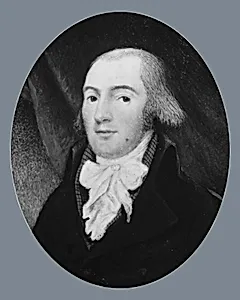
Cornelius George Bowler
Edward Greene Malbone, ca. 1795
About this artwork
Step into the intimate world of early American portraiture with *Cornelius George Bowler*, a delicate watercolor miniature on ivory painted around 1795 by Edward Greene Mal. This tiny gem, measuring just 2 5/64 x 1 19/32 inches (5.3 x 4 cm), captures poised likeness of its namesake subject—a refined gentleman of the Federal era—showcasing Malbone's mastery in rendering lifelike expressions on such a minuscule scale. Housed in The Metropolitan Museum of Art's American Wing, it reflects the elegance of post-Revolutionary America, where such portraits served as cherished personal mementos. Malbone, one of America's premier miniaturists (1777–1807), elevated the watercolor-on-ivory technique to luminous heights. He applied translucent layers of pigment to thinly sliced ivory, achieving a glowing, jewel-like depth that mimicked the era's fashionable enamel work. This medium was ideal for miniatures, often set into lockets or brooches, allowing sitters like Cornelius George Bowler to carry a piece of their identity—or a loved one's—close to the heart. These portraits hold cultural significance as windows into elite American society, blending European traditions with emerging national identity. Acquired through the Fletcher Fund in 1940, this work exemplifies the artistry that made Malbone a sought-after talent in cities like Providence and Charleston, preserving the faces of a young republic's leaders and merchants for generations.