
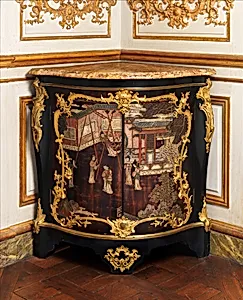
Corner cabinet (encoignure) (one of a pair)
ca. 1745–49
Medium
Oak veneered with ebony and Coromandel lacquer, cherry wood, and purplewood; gilt-bronze mounts; brocatelle marble top
Dimensions
H. 35-7/8 x W. 33-7/8 x D. 26-1/8 in. (91.1 x 86.0 x 66.4 cm)
Classification
Woodwork-Furniture
Culture
French, Paris
Department
European Sculpture and Decorative Arts
Museum
Metropolitan Museum of Art, New York, NY
Credit
Gift of Mr. and Mrs. Charles Wrightsman, 1983
Accession Number
1983.185.2a, b
Rights
Public Domain
Tags
Art Historical Context
This elegant corner cabinet, or *encoignure*, crafted Parisian master Bernard II van Rburgh around 1745–49, the exuberant Rococo style of XV's France. One of a matching pair, it was designed to fit snugly into salon corners, maximizing space in opulent aristocratic interiors while serving as a pedestal for displaying porcelain, silver, or curiosities. Van Rburgh, a leading *ébéniste*, was renowned for his innovative use of exotic materials, blending European craftsmanship with global influences to create furniture that radiated luxury and refinement. The cabinet's construction highlights virtuoso techniques: a sturdy oak frame veneered in ebony for a sleek contrast, inlaid with rare Coromandel lacquer panels—Chinese screens repurposed from India via maritime trade routes—depicting intricate scenes often featuring graceful women. Gilt-bronze mounts, with scrolling foliage and delicate figures, add playful asymmetry, while the brocatelle marble top provides a polished surface for treasured objects. These elements underscore the era's fascination with *chinoiseries* and the height of French decorative arts. A generous gift to the Metropolitan Museum of Art from Mr. and Mrs. Charles Wrightsman in 1983, this piece invites visitors to imagine the lavish world of 18th-century Paris, where furniture was both functional art and a statement of wealth and sophistication. (218 words)