
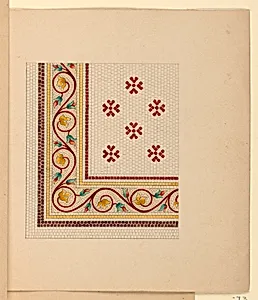
Corner Design for Mosaic Floor
Classification
tiles
Department
Smithsonian Collection
Museum
Smithsonian American Art Museum
Credit
Gift of Theodore A. Krieg
Accession Number
1984-125-73
Rights
Public Domain
About this artwork
Research in Progress
Art Historical Context
Frederick Krieg's *Corner Design for Mosaic Floor* (. 1900) the exquisite craftsmanship of early 20th-century American arts. Born in Germany in 1852 and later becoming an American artist, Krieg brought European tile-making expertise to the United States during a time when ornate interiors were all the rage in grand homes, public buildings, and urban spaces. This intricate design, classified as tiles, was likely intended as a decorative element for the corner of a larger mosaic floor, showcasing the precision required to create harmonious patterns that could withstand daily foot traffic. Mosaic floors, popular in the Arts and Crafts and emerging Art Nouveau movements, blended functionality with artistry, using durable materials like ceramic or glass tesserae to form elaborate motifs. Krieg's contribution highlights the immigrant influence on American design, as European-trained artisans like him helped elevate tilework from utilitarian to ornamental. Though the exact medium awaits further research, such pieces reflect the era's fascination with symmetry, nature-inspired flourishes, and enduring beauty. Generously gifted to the Smithsonian American Art Museum by Theodore A. Krieg—likely a family member—this artwork invites us to appreciate the unsung heroes of architectural embellishment. Ongoing research promises to uncover more about Krieg's techniques and commissions, enriching our understanding of America's Gilded Age aesthetics.