
Cornice Relief
Unknown Artist
4th–7th century
Medium
Stone, metal inlay
Dimensions
Overall: 7 15/16 x 15 1/16 x 5 3/16 in. (20.2 x 38.3 x 13.2 cm) Face: 5 13/16 in. (14.7 cm)
Classification
Sculpture-Architectural-Stone
Culture
Coptic
Department
Medieval Art
Museum
Metropolitan Museum of Art, New York, NY
Credit
Unknown source
Accession Number
949
Rights
Public Domain
Tags
Art Historical Context
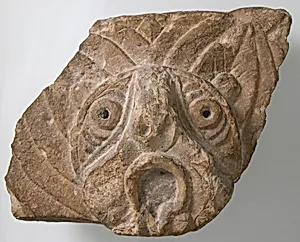
This exquisite Cornice Relief, dating from the 4th to 7th century, hails from Coptic Egypt, a vibrant era when early Christianity blended with ancient Egyptian, Greco-Roman, and local traditions. As an architectural sculpture, it would have adorned the upper edge of a building—perhaps a church doorway or window—serving both structural and decorative purposes. Coptic art, classified here in the Medieval Art department of the Metropolitan Museum of Art, often featured such stone carvings to elevate sacred spaces with symbolic motifs. Crafted from stone with intricate metal inlays, the relief showcases masterful low-relief carving, particularly of expressive faces that dominate its surface. The metal accents—likely silver or gold—would have caught the light, adding a luminous, jewel-like quality that emphasized facial features and conveyed spiritual presence or portrait-like realism. Measuring just under 8 inches high and 15 inches wide, its compact scale belies its monumental architectural role. In Coptic culture, these reliefs highlight the community's artistic ingenuity amid religious transformation, bridging pagan pasts with Christian futures. Gaze upon the faces, and imagine them watching over worshippers in sunlit basilicas, a testament to enduring faith and craftsmanship.