
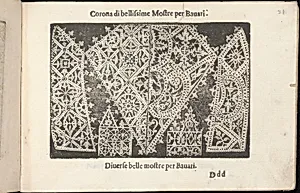
Corona delle Nobile et Virtuose Donne, Libro Terzo, page 21 (recto)
Medium
Woodcut
Dimensions
Overall: 5 1/2 x 7 11/16 in. (14 x 19.5 cm)
Classification
Books|Prints|Ornament & Architecture
Department
Drawings and Prints
Museum
Metropolitan Museum of Art, New York, NY
Credit
Gift of the Guild of Book Workers, 1960
Accession Number
60.718.1(22)
Rights
Public Domain
Tags
Art Historical Context
Step into the opulent world of early 17th-century Italy this delicate woodcut from *Cor delle Nobile et Virose Donne, Libro Ter* (Crown of Noble Virtuous Women, Book), page 21 recto. Crafted around 1620 by Alessandro' Vecchi and Cesareellio, the print measures a modest 5½ × 7⅝ inches (14 × 19.5 cm), perfectly sized for a collector's volume. Housed in the Metropolitan Museum of Art's Drawings Prints department—thanks to a 1960 gift from the Guild of Book Workers—it exemplifies the era's blend of books, prints, and ornamental design. Cesare Vecellio, a Venetian master of woodcut illustration famed for his detailed costume books like *Habiti Antichi et Moderni*, likely contributed intricate patterns here, tagged simply as "Ornament." Woodcuts, carved into wooden blocks and printed with ink, were ideal for reproducing fine motifs affordably, influencing fashion, textiles, and architecture. This page, classified under Ornament & Architecture, probably showcases decorative elements inspired by noblewomen—think lace-like borders, floral arabesques, or symbolic motifs evoking virtue and elegance during the Renaissance-Baroque transition. Culturally, such prints celebrated idealized femininity while serving practical purposes: patterns for embroidery, dressmaking, or interior adornment. They reflect Italy's vibrant print culture, where art democratized luxury for aspiring elites, inviting us today to admire the meticulous craftsmanship that crowned women's grace in visual form.
About the Artist
Alessandro de' Vecchi|Cesare Vecellio (Italian|Italian) · 1570 |1521 –1629 |1601
Italian, active Venice, 1570–1629|Italian, Pieve di Cadore 1521–1601 Venice